
Choosing the right eCommerce platform in 2026 is one of the most important technical and business decisions for any company planning to sell online. The platform you choose will affect your store speed, SEO, scalability, security, integrations, mobile experience, development costs, and long-term growth.
The three most popular options are Magento 2, Shopify, and WooCommerce. Each platform can be the right choice, but not for the same type of business.
Magento 2 is powerful and scalable. Shopify is fast to launch and easier to manage. WooCommerce is flexible and suitable for WordPress-based businesses. The real question is not “Which platform is best?” The correct question is: Which platform is best for your business model, budget, technical needs, and growth plan?
Quick Comparison: Magento 2, Shopify, and WooCommerce
| Feature | Magento 2 | Shopify | WooCommerce |
|---|---|---|---|
| Best For | Medium to enterprise stores | Startups and growing brands | Small to medium WordPress stores |
| Scalability | Very high | High, with limits | Medium |
| Customization | Very high | Medium | High |
| Ease of Use | Technical | Easy | Medium |
| SEO Flexibility | Very high | Good | High |
| Security | Strong with proper maintenance | Managed by Shopify | Depends on hosting and plugins |
| Cost | Higher initial cost | Monthly SaaS cost | Lower initial cost |
What Is Magento 2?
Magento 2 is an open-source eCommerce platform designed for businesses that need flexibility, scalability, and full control over their online store. It is especially strong for companies with large catalogs, complex product structures, multiple warehouses, ERP integrations, B2B functionality, custom pricing, and advanced checkout requirements.
Magento 2 is not just a website builder. It is a full eCommerce framework. This means it gives developers and business owners the ability to build highly customized online stores with advanced business logic.
For example, if your business needs different prices for different customer groups, complex shipping rules, custom checkout fields, ERP synchronization, mobile app APIs, multi-store architecture, or advanced product filtering, Magento 2 is usually one of the strongest choices.
Main Advantages of Magento 2
1. High Scalability
Magento 2 can handle large product catalogs, high traffic, and complex business operations when it is developed and hosted correctly. Stores with tens of thousands or hundreds of thousands of products can run on Magento 2 with the right infrastructure.
A properly configured Magento 2 setup may include Redis, Varnish, OpenSearch, optimized MySQL, PHP-FPM tuning, CDN, Cloudflare, queue consumers, cron optimization, and server monitoring.
2. Full Customization
Magento 2 allows deep customization of almost every part of the store. Developers can customize product pages, checkout, customer accounts, order workflows, payment methods, shipping logic, admin panels, APIs, and frontend behavior.
This is one of the main reasons many serious eCommerce businesses choose Magento. The platform does not force you to work only inside strict SaaS limitations.
3. Strong SEO Control
Magento 2 gives strong control over technical SEO. You can manage meta titles, meta descriptions, URLs, canonical tags, robots settings, XML sitemaps, structured data, layered navigation, pagination, category SEO, product SEO, and multilingual SEO.
This is very important for businesses that depend on organic search traffic. Large stores need clean technical SEO architecture. Otherwise, thousands of product and category pages can create duplicate content, crawl waste, and indexing problems.
4. Multi-Store Functionality
Magento 2 supports multiple websites, stores, and store views from one administration panel. This is useful for companies operating in several countries, languages, brands, or business models.
For example, one Magento installation can manage separate stores for Armenia, Georgia, and Europe with different languages, currencies, taxes, and product catalogs.
5. Advanced Integrations
Magento 2 is strong for integrations. It can be connected with ERP systems, CRM systems, accounting software, warehouse systems, payment gateways, delivery providers, loyalty systems, analytics platforms, and mobile applications.
Disadvantages of Magento 2
1. Higher Development Cost
Magento 2 usually requires a higher initial investment than Shopify or WooCommerce. Development takes more time because the platform is more complex and powerful.
If a business wants a serious Magento 2 store, it should budget for professional development, UI/UX design, backend customization, server setup, testing, performance optimization, and maintenance.
2. Requires Technical Support
Magento 2 is not ideal for businesses that want to avoid technical responsibility completely. It requires developers, DevOps knowledge, updates, security patches, backups, monitoring, and performance maintenance.
3. Poor Setup Can Become Slow
Magento 2 is powerful, but if it is badly configured, it can become slow. Bad hosting, poor code quality, too many third-party modules, wrong cache configuration, and unoptimized database queries can damage performance.
This is why Magento 2 should be developed by a team that understands not only coding, but also infrastructure, SEO, performance, and eCommerce operations.
What Is Shopify?
Shopify is a SaaS eCommerce platform. This means Shopify manages the hosting, security, core updates, and infrastructure for you. Business owners can focus more on products, branding, marketing, and sales instead of server management.
Shopify is very popular with small and medium businesses, fashion brands, beauty brands, creators, dropshipping stores, and businesses that want to launch quickly.
Main Advantages of Shopify
1. Fast Launch
Shopify is one of the fastest ways to launch an online store. You can choose a theme, upload products, configure payment methods, connect shipping, and start selling without building a full custom system from zero.
This is a major advantage for businesses that want to test a product, validate a niche, or start selling quickly.
2. Easy Administration
Shopify has a clean and simple admin panel. Store owners can manage products, collections, discounts, orders, customers, and reports without needing strong technical knowledge.
3. Managed Security and Hosting
Shopify handles hosting, SSL, platform security, and server maintenance. This reduces operational risk for small businesses that do not have technical teams.
4. Strong App Ecosystem
Shopify has a large app ecosystem. Businesses can add marketing tools, review systems, upsell apps, email marketing, analytics, subscriptions, loyalty programs, and integrations through apps.
5. Good for Brand-Driven Sales
Shopify works well for businesses focused on branding, social media, influencer marketing, Meta ads, TikTok ads, and direct-to-consumer sales.
Disadvantages of Shopify
1. Limited Backend Control
Shopify is easy because it is controlled. But the same control creates limitations. Businesses cannot fully customize backend logic the way they can with Magento 2 or custom development.
If your store needs very specific workflows, advanced ERP logic, complex B2B pricing, custom checkout behavior, or deep system-level changes, Shopify may become limiting.
2. Monthly App Costs
Shopify may look affordable at the beginning, but monthly costs can grow as the business adds more apps. Many useful features require paid apps.
Over time, a store may pay for theme costs, Shopify subscription, transaction fees, third-party apps, email tools, review apps, upsell apps, and custom development.
3. SEO Limitations
Shopify SEO is good enough for many businesses, but it has limitations compared with Magento 2. URL structures, advanced filtering, complex category SEO, and deep technical SEO customization are more restricted.
What Is WooCommerce?
WooCommerce is an eCommerce plugin for WordPress. It allows WordPress websites to sell products online. WooCommerce is popular because WordPress is widely used and many businesses already have WordPress websites.
WooCommerce is often a good choice for small businesses, content-driven websites, blogs, service businesses with small product catalogs, and companies that want strong control over content marketing.
Main Advantages of WooCommerce
1. Strong Content Management
WooCommerce benefits from WordPress. This means businesses can easily publish blogs, landing pages, guides, SEO content, and educational materials.
If content marketing is a major part of your growth strategy, WooCommerce can be useful.
2. Lower Initial Cost
WooCommerce can be cheaper to start with than Magento 2. Many themes and plugins are available, and businesses can launch a basic store with a smaller budget.
3. Flexible Plugin Ecosystem
WooCommerce has plugins for payments, shipping, SEO, product variations, subscriptions, memberships, invoices, analytics, and marketing.
4. Good for Small Catalogs
WooCommerce works well for stores with a limited number of products and simple business logic.
Disadvantages of WooCommerce
1. Scaling Problems
WooCommerce can become difficult to scale when the product catalog grows, traffic increases, or business logic becomes more complex.
Large WooCommerce stores often face database load issues, plugin conflicts, slow admin panels, checkout problems, and caching difficulties.
2. Plugin Dependency
WooCommerce stores often depend on many plugins. Each plugin adds functionality, but also adds risk. Plugin conflicts, abandoned plugins, security vulnerabilities, and update problems are common issues.
3. Security Responsibility
WooCommerce security depends heavily on hosting quality, plugin quality, WordPress updates, admin security, firewall rules, and maintenance.
A poorly maintained WooCommerce store can become vulnerable to malware, spam, brute-force attacks, and checkout abuse.
Magento 2 vs Shopify vs WooCommerce: Cost Comparison
Cost is one of the most misunderstood parts of eCommerce platform selection. Many businesses compare only the launch cost, but the real cost includes maintenance, development, apps, hosting, performance optimization, security, SEO, and future scaling.
Magento 2 Cost
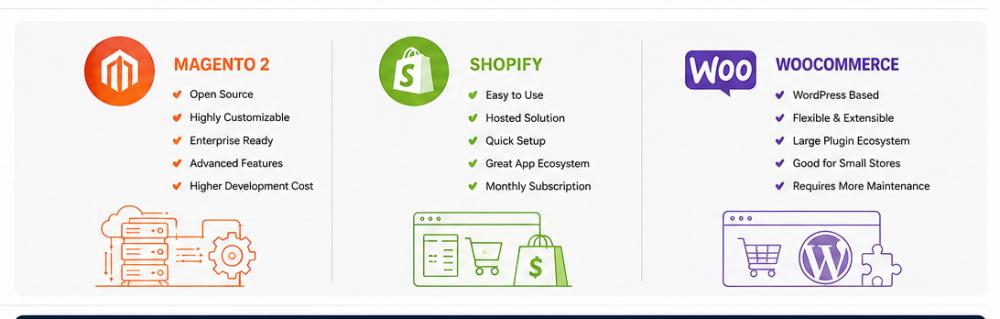
Magento 2 usually has a higher initial cost. You need professional design, frontend development, backend development, server setup, testing, integrations, and maintenance.
However, Magento gives strong long-term control. You are not fully dependent on monthly apps or platform restrictions.
Shopify Cost
Shopify has a lower entry cost, but monthly expenses can increase with apps, premium themes, transaction fees, Shopify Plus, and custom development.
Shopify is cost-effective for simple stores and fast launches, but advanced business requirements may become expensive.
WooCommerce Cost
WooCommerce can be cheap at the beginning, but costs increase with premium plugins, hosting, security, performance work, maintenance, and developer support.
For small stores, WooCommerce can be affordable. For large stores, it can become complex and unstable if not managed professionally.
| Cost Factor | Magento 2 | Shopify | WooCommerce |
|---|---|---|---|
| Initial Development | High | Low to medium | Low to medium |
| Monthly Platform Cost | Hosting + support | Subscription + apps | Hosting + plugins |
| Maintenance | Required | Lower | Required |
| Scaling Cost | Predictable with good architecture | Can increase with apps and Shopify Plus | Can become expensive with optimization |
SEO Comparison
Magento 2 SEO
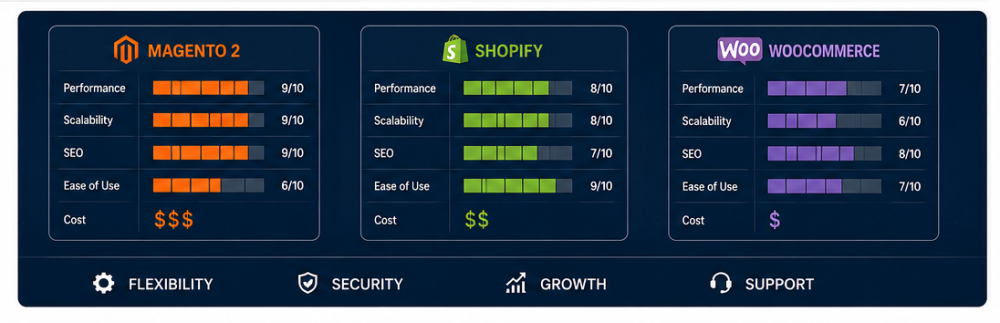
Magento 2 is strong for technical SEO. It is suitable for businesses that need advanced category structures, large product catalogs, multilingual SEO, structured data, advanced URL control, and custom SEO logic.
Magento is especially useful when SEO is a serious long-term acquisition channel.
Shopify SEO
Shopify has good basic SEO functionality. It handles many technical parts automatically and works well for many small and medium stores.
However, advanced SEO customization can be limited. Stores with complex filtering, large catalogs, and strict technical SEO requirements may need workarounds.
WooCommerce SEO
WooCommerce can be strong for SEO because it works with WordPress. WordPress is excellent for blogging and content marketing.
But WooCommerce SEO quality depends heavily on site speed, theme quality, plugin setup, hosting, and technical optimization.
Performance and Scalability Comparison
Magento 2 Performance
Magento 2 can be extremely fast when optimized correctly. It needs proper infrastructure and clean development practices.
A professional Magento 2 performance setup may include:
- Varnish full-page cache
- Redis cache and sessions
- OpenSearch optimization
- MySQL query optimization
- PHP-FPM tuning
- CDN and Cloudflare
- Image optimization
- JavaScript optimization
- Cron and queue optimization
Shopify Performance
Shopify generally performs well because hosting is managed. However, too many apps, heavy themes, large scripts, and poorly optimized images can slow down a Shopify store.
WooCommerce Performance
WooCommerce performance depends heavily on hosting, theme quality, plugin count, caching, database optimization, and CDN usage.
WooCommerce can be fast for small stores, but large catalogs and heavy plugins can create serious speed problems.
Security Comparison
Magento 2 Security
Magento 2 can be very secure, but it requires professional maintenance. Security patches, server hardening, admin protection, WAF rules, bot protection, backups, and monitoring are necessary.
Shopify Security
Shopify provides managed security. This is one of its strongest advantages. Store owners do not need to manage server-level security.
WooCommerce Security
WooCommerce security depends on WordPress maintenance. Outdated plugins, weak passwords, poor hosting, and missing firewall rules can create serious risks.
Mobile Commerce
In 2026, mobile commerce is not optional. Most users browse and buy from mobile devices. Your platform should support fast mobile pages, simple checkout, responsive design, and app integration possibilities.
Magento 2 Mobile
Magento 2 can support responsive themes, PWA storefronts, and mobile applications through APIs and GraphQL.
Shopify Mobile
Shopify themes are usually mobile-friendly, and the checkout experience is optimized for mobile users.
WooCommerce Mobile
WooCommerce mobile quality depends on the selected theme and plugins. A bad WordPress theme can damage mobile conversion rates.
Which Platform Is Best for Different Business Types?
Small Startup
For a small startup that wants to test products quickly, Shopify is often the best choice. It allows fast launch, simple management, and easier marketing setup.
Content-Based Business
For a business that depends heavily on content, articles, guides, education, or SEO blogging, WooCommerce can be a strong option because of WordPress.
Large Retailer
For a large retailer with many products, warehouse logic, ERP integrations, and serious scaling needs, Magento 2 is usually the stronger choice.
B2B Company
For B2B eCommerce, Magento 2 is usually stronger because it supports complex customer groups, custom pricing, quote requests, company accounts, approval workflows, and advanced integrations.
Fashion or Beauty Brand
Shopify can be excellent for fashion and beauty brands focused on visual branding, social media, influencer marketing, and fast product launches.
Enterprise Business
Enterprise businesses usually need Magento 2 or custom eCommerce development because they require control, integrations, data ownership, scalability, and advanced workflows.
When Should You Choose Custom eCommerce Development?
Sometimes Magento 2, Shopify, and WooCommerce are not enough. Custom eCommerce development may be better when the business model is unique and cannot fit inside a standard platform.
Custom development may be suitable for:
- marketplaces,
- subscription systems,
- advanced B2B portals,
- complex product configurators,
- custom mobile-first commerce platforms,
- AI-based recommendation systems,
- and highly specific business workflows.
However, custom development requires serious planning, higher budget, technical documentation, long-term maintenance, and a strong development team.
Final Recommendation
There is no single best eCommerce platform for every business.
Choose Magento 2 if your business needs scalability, integrations, large catalog management, advanced SEO, custom workflows, ERP connection, and long-term technical control.
Choose Shopify if your business needs fast launch, simple management, strong branding, social commerce, and lower technical responsibility.
Choose WooCommerce if your business is content-driven, WordPress-based, smaller in catalog size, and needs affordable flexibility.
Choose custom eCommerce development if your business model is unique and standard platforms limit your growth.
How ArmMage Can Help
ArmMage provides full eCommerce solutions for businesses that want to launch, improve, secure, scale, or grow their online stores.
Our services include:
- Magento 2 development
- Shopify development
- WooCommerce development
- Custom eCommerce development
- Mobile app development for eCommerce
- UI/UX design
- SEO optimization
- Performance optimization
- Security hardening
- Infrastructure architecture
- Marketing and growth consulting
Before choosing a platform, your business should clearly understand current needs, future scaling plans, budget, technical requirements, integrations, SEO goals, and operational capacity.
A good platform decision can save years of technical problems. A bad decision can create expensive migrations, lost rankings, slow performance, and operational limitations.
If your business is planning to launch or improve an eCommerce project in 2026, ArmMage can help you choose the right platform and build a stable, scalable, and growth-focused online store.
Frequently Asked Questions
Which platform is better: Magento or Shopify?
Magento 2 is better for businesses that require advanced customization, ERP integrations, large product catalogs, enterprise-level scalability, and full technical control. Shopify is better for businesses that want faster launch, easier management, lower technical responsibility, and strong branding-focused commerce. The best choice depends on your business size, technical requirements, and long-term growth strategy.
Is WooCommerce good for large ecommerce stores?
WooCommerce can support medium-sized stores, but very large ecommerce projects may face scalability and performance limitations. Large catalogs, high traffic, heavy plugin dependency, and complex business logic often require significant optimization and infrastructure work. Enterprise businesses usually prefer Magento 2 or custom ecommerce solutions for better long-term scalability.
Which ecommerce platform is best for SEO?
Magento 2 provides the strongest technical SEO flexibility for large ecommerce businesses, including advanced control over structured data, canonical tags, layered navigation, metadata, and multilingual SEO. WooCommerce is strong for content marketing because of WordPress. Shopify offers good SEO for most businesses but has more technical limitations compared with Magento 2.
Is Magento 2 better than WooCommerce?
Magento 2 is generally better for medium and large ecommerce businesses that need scalability, advanced integrations, multi-store management, and enterprise-level functionality. WooCommerce is better for smaller businesses, content-driven websites, and WordPress users looking for lower initial costs and easier content management.
Which platform is easier for beginners?
Shopify is usually the easiest platform for beginners because it manages hosting, security, updates, and infrastructure automatically. WooCommerce requires some WordPress knowledge, while Magento 2 is more technical and usually requires experienced developers and infrastructure management.
Comments
Sign in to like or reply to comments.